

Early Life and Career Beginnings
Bo Burnham, born Robert Pickering Burnham on August 21, 1990, in Hamilton, Massachusetts, developed an interest in performance at a relatively young age. Raised in a family with strong educational and professional backgrounds—his mother worked as a hospice nurse and his father owned a construction company—Burnham was not initially positioned within the traditional entertainment industry. Despite this, he showed early aptitude for music and comedy, often combining the two in a way that would later define his career.
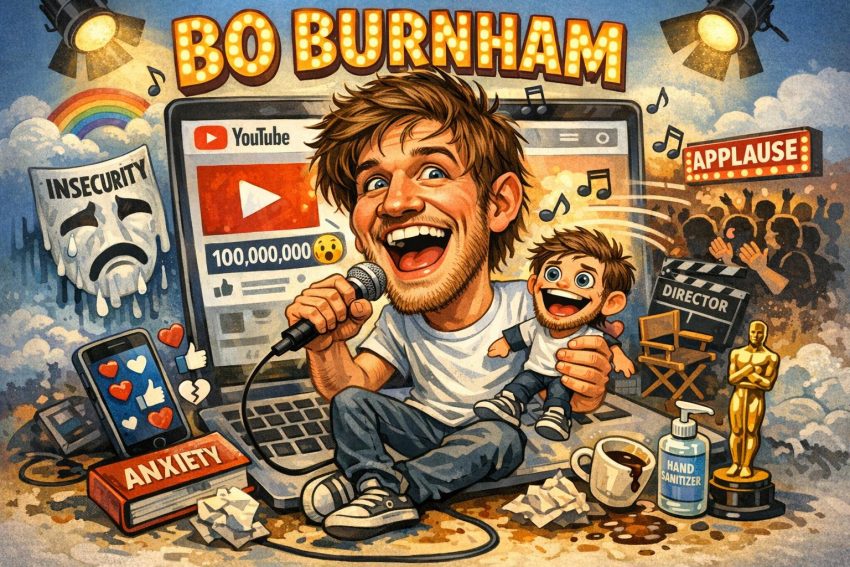
Burnham attended St. John’s Preparatory School, where he was involved in theater and academic extracurriculars. His early exposure to performance came through school productions and personal experimentation with songwriting and comedic material. In 2006, during his senior year of high school, he began recording videos in his bedroom and uploading them to YouTube. These videos featured Burnham sitting at a keyboard, delivering rapid-fire lyrical jokes marked by wordplay, satire, and an awareness of performance itself.
The timing of his online emergence coincided with the early expansion of YouTube as a platform for amateur creators. Burnham’s content stood out due to its combination of musical composition and tightly structured humor. His videos quickly attracted millions of views, and this online visibility translated into broader opportunities. Within a relatively short period, he transitioned from a high school student uploading casual recordings to a performer recognized within the evolving digital entertainment landscape.
Breakthrough with Comedy Specials
Burnham’s move from online personality to professional comedian occurred rapidly. In 2008, at the age of 18, he signed a four-album deal with Comedy Central Records, becoming one of the youngest comedians to secure such an agreement. That same year, he released his debut comedy special, Bo Burnham: Words, Words, Words. The special demonstrated a level of polish that contrasted with his earlier bedroom recordings, while still preserving the intellectual and musical style that defined his work.
The structure of Words, Words, Words emphasized Burnham’s ability to merge stand-up with original music. His use of rhyme schemes, abrupt tonal shifts, and deliberate subversion of comedic expectations positioned him as distinct from more traditional stand-up performers. Rather than relying solely on observational humor, Burnham often deconstructed the form of comedy itself, drawing attention to timing, audience reactions, and the constructed nature of performance.
Following this debut, Burnham continued to refine his stage presence and thematic scope. His 2013 special, what., marked a noticeable evolution in both production scale and conceptual ambition. The show incorporated elaborate lighting cues, prerecorded audio segments, and moments of intentional self-awareness. Burnham frequently broke the fourth wall, acknowledging the artificiality of the performance while still maintaining comedic momentum.
In 2016, he released Make Happy, a special that is often regarded as a turning point in his career. While still comedic, the material increasingly addressed issues such as audience expectation, performer identity, and the pressures associated with public visibility. The final segment of Make Happy, which diverged from traditional stand-up into a more introspective monologue, suggested a shift in Burnham’s creative direction. Shortly after its release, he announced a step back from live performance, citing anxiety and a desire to explore other forms of artistic expression.
Expanding into Filmmaking
Burnham’s transition into filmmaking represented a significant expansion of his creative scope. Rather than performing on stage, he began working behind the camera, focusing on writing and directing. This shift culminated in the release of Eighth Grade in 2018, his debut feature film.
The film follows a teenage girl navigating the final week of middle school, addressing themes such as social anxiety, digital identity, and adolescent self-perception. Burnham drew from observational research, including extensive engagement with online content created by teenagers, to inform the film’s tone and authenticity. The result was a narrative that avoided exaggeration in favor of subtle, realistic portrayals of everyday experiences.
Eighth Grade was widely praised by critics for its empathetic approach and attention to detail. Rather than presenting adolescence as either comedic or overly dramatic, Burnham depicted it as a complex and often uncomfortable transitional period. The film’s use of close framing and naturalistic dialogue contributed to its immersive quality, while its restrained pacing allowed emotional moments to develop without overt manipulation.
The success of Eighth Grade established Burnham as a filmmaker capable of translating his insights into a different medium. He received several awards, including recognition from the Writers Guild of America for Best Original Screenplay. The project demonstrated that his creative abilities extended beyond performance, encompassing narrative construction, character development, and visual storytelling.
Innovative Performances during the COVID-19 Pandemic
After several years largely spent away from live comedy, Burnham returned with the 2021 special Inside. Produced during the COVID-19 pandemic, the project differed significantly from his earlier work in both format and content. Filmed entirely within a single interior space, the special was created without a live audience, external crew, or traditional production infrastructure.
Inside combined elements of music, comedy, and visual experimentation. Burnham served as writer, performer, director, cinematographer, and editor, using available equipment to construct a series of interconnected segments. The special addressed a range of topics, including internet culture, mental health, consumerism, and the experience of prolonged isolation. Its fragmented structure mirrored the disorientation associated with extended periods of confinement.
Technically, the special demonstrated a high level of precision. Burnham employed lighting changes, camera movements, and editing techniques to create variation within a limited physical space. Songs were staged with deliberate visual contrasts, shifting between minimalism and more complex compositions. This approach allowed the special to maintain visual and tonal diversity despite its constrained setting.
The reception of Inside reflected both its technical execution and thematic relevance. Audiences and critics noted its ability to capture aspects of the pandemic experience without relying on direct narrative. Instead, Burnham used metaphor and abstraction to convey broader emotional and cultural dynamics. The project received multiple awards and contributed to ongoing discussions about the evolving boundaries of comedy as a genre.
Additional Pursuits and Continuing Influence
In addition to his work in performance and film, Burnham has explored other creative formats. His book, Egghead: Or, You Can’t Survive on Ideas Alone, consists of a collection of poems, drawings, and short texts. The content reflects his established style, combining humor with linguistic experimentation and occasional abstract elements. The book format offered a different medium through which to present his ideas, emphasizing brevity and visual composition.
Burnham has also contributed to projects as an actor and producer. His acting roles, though less central to his public identity, demonstrate an interest in collaborative work within the broader entertainment industry. Additionally, his involvement in directing comedy specials for other performers has extended his influence beyond his own material, shaping the presentation and structure of contemporary stand-up.
A recurring aspect of Burnham’s work is its engagement with the mechanisms of performance and media. Whether through live shows, film, or recorded specials, he frequently examines how audiences interact with content and how creators respond to those expectations. This meta-commentary distinguishes his work from more conventional comedic approaches, positioning it within a broader cultural and analytical context.
His impact can also be observed in the way newer comedians incorporate multimedia elements into their work. The integration of music, lighting, and narrative structure in stand-up has become more common, and Burnham’s early adoption of these techniques contributed to their wider acceptance. While not solely responsible for these developments, his visibility and experimentation have played a role in shaping the direction of the field.
Despite periods of reduced public output, Burnham’s projects tend to generate sustained attention due to their distinctive approach. Rather than maintaining a constant presence, he has often worked in extended cycles, focusing on specific projects before withdrawing from public performance. This pattern has allowed for significant variation between works, with each release reflecting a different set of concerns and methods.
Overall, Bo Burnham’s career demonstrates a consistent interest in exploring the boundaries of comedy and performance. From early YouTube videos to structured specials and feature filmmaking, his work reflects an evolving engagement with both form and content. By combining technical experimentation with thematic depth, he has contributed to ongoing discussions about the role of comedy in contemporary media and the possibilities available within it.